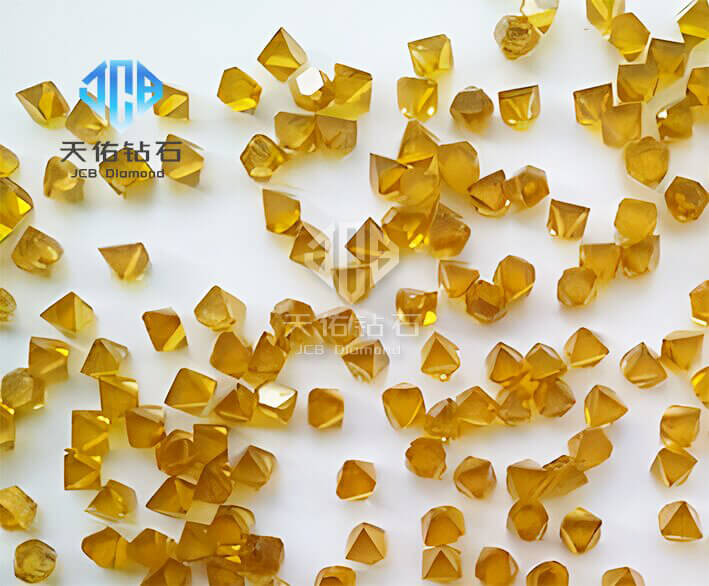
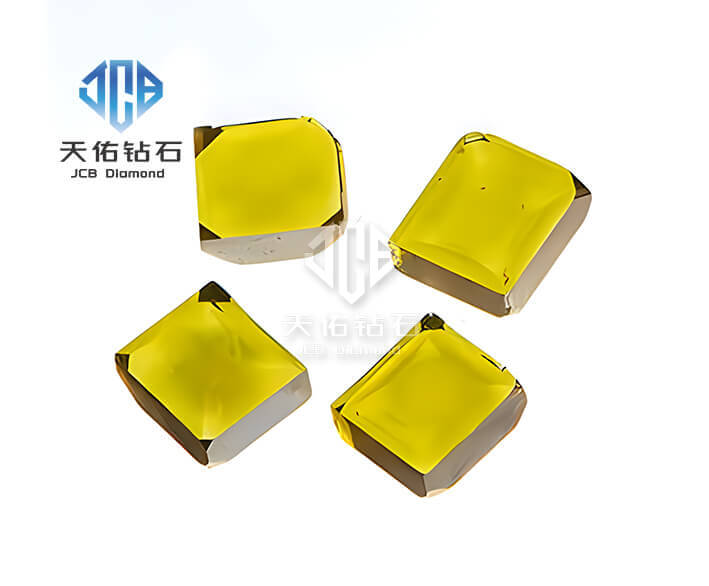
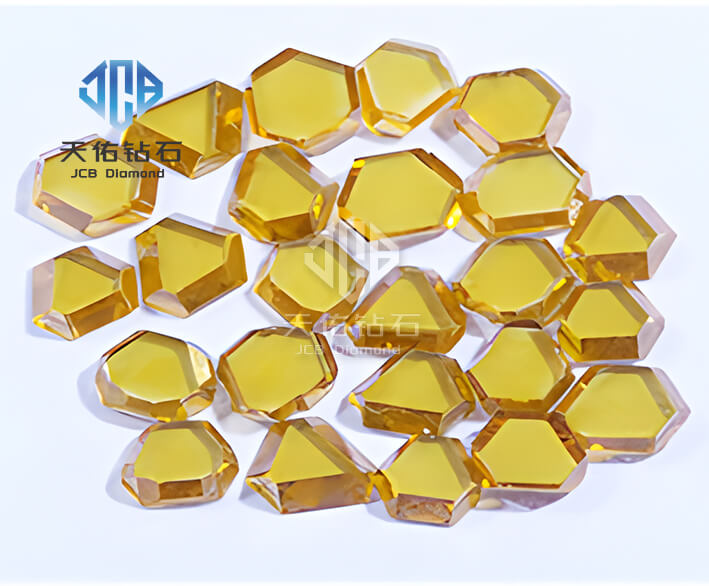
Due to its extremely high thermal conductivity, and particularly the ability to produce large, wafer-like materials, CVD diamond is poised to become the most ideal heat sink material to date. Its most important application is heat dissipation for high-power-density electronic devices. Research has shown that for every 10-degree increase in the operating temperature of a laser diode, its lifespan decreases by 50%. Using CVD diamond as a heat sink material can increase output power and reduce the junction temperature of the diode, thereby significantly extending the device’s lifespan and stabilizing the output optical amplification wavelength.
Another representative application of CVD diamond in heat sinks is the TAB (Tape-on-Au-bonding) tool used in the assembly of large-scale integrated circuits. TAB tools are used in the bonding process for multi-pin integrated circuit chips found in IC cards, calculators, and liquid crystal displays. They are characterized by heat resistance, wear resistance, and corrosion resistance, and, in particular, excellent thermal conductivity.
With the continuous advancement of CVD technology, the transmittance and thermal conductivity of the high-quality diamond films produced are now very close to those of the best natural diamonds (Type IIa), and they can be fabricated in large-area and curved forms. Although diamond-like carbon (DLC) films prepared on silicon substrates have a wide infrared transmission band with an infrared transmittance approaching 90%, their mechanical properties are inferior to those of diamond films, and they exhibit poor adaptability under harsh environmental conditions.
CVD diamond films possess excellent heat dissipation properties. As electronic devices become increasingly miniaturized while their power output continues to rise, the resulting heat dissipation challenges have become a critical issue in microelectronic packaging technology. Currently, there are already examples of CVD diamond film applications in heat pipes overseas, primarily addressing system heat dissipation issues caused by high-power, high-heat-flux-density components. These include high-power laser diode arrays, two-dimensional multi-chip modules (MCMs), and heat dissipation applications for solid-state microwave power devices.
CVD diamond possesses the same maximum thermal conductivity as single-crystal Type Ia diamond and is widely used as a heat dissipation component for high-power-density, high-end devices in the most dynamic fields, such as electronics, optoelectronics, and optical communications. It is primarily used in high-tech fields such as laser diodes and arrays, high-speed computer CPU chips and multi-dimensional integrated circuits, thermal support rods for military high-power radar microwave traveling wave tubes, microwave integrated circuit substrates, and TAB (Tape and Bond) for automated integrated circuit packaging.
A new super-heat-dissipating material designed for cooling. The higher the performance of electronic products, the more challenging thermal management becomes, as the continuous increase in the power density of semiconductor components leads to ever-greater heat flux—in some cases reaching tens of kW/cm², which is five times that of the sun’s surface. The direction of semiconductor development is no longer limited to performance enhancement alone; heat generation and thermal dissipation performance have also become critical factors in semiconductor design. Heat generation is primarily related to chip manufacturing processes and temperature control methods, while thermal dissipation performance can be optimized through material selection and product structure.