With the continuous advancement of technology, an increasing number of high-power electrical appliances and high-power microelectronic components are emerging. As demand for thinner, lighter, and more efficient electronic products grows, the power density of semiconductor components continues to rise, leading to ever-greater heat flux. Conventional heat dissipation materials are no longer sufficient to effectively address heat dissipation challenges, making the effective cooling of these materials a top priority.
So, how should materials be selected in the field of thermal management? Currently, the most popular thermal management solutions include graphite sheets, graphene, thermal interface materials, heat pipes, heat spreaders, and semi-solid die-cast components. However, natural graphite heat dissipation products are relatively thick and currently have low thermal conductivity, making it difficult to meet the thermal management needs of future high-power, high-integration-density devices. At the same time, they do not meet the high-performance requirements for ultra-lightweight, ultra-thin designs, and long battery life. Therefore, the search for new materials with ultra-high thermal conductivity is of paramount importance. Such materials must possess an extremely low coefficient of thermal expansion, ultra-high thermal conductivity, and a lightweight, thin profile. Carbon materials such as diamond and graphene perfectly meet these requirements; they possess very high thermal conductivity, and their composite materials represent a class of thermal management materials with immense application potential, having already become the focus of widespread attention.
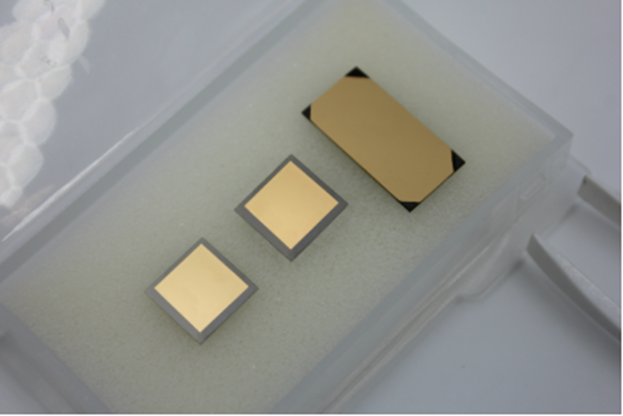
The thermal conductivity of diamond is not fixed but varies within a certain range. The primary materials used for diamond heat sinks are Type 19 single-crystal diamonds and polycrystalline diamonds that meet the required thermal conductivity specifications. Their coefficient of thermal expansion is approximately 0.8 × 10⁻⁶ K, and they are electrically insulating at room temperature. Diamond has a cubic crystal structure, in which each carbon atom forms covalent bonds with four other carbon atoms via sp³ hybridized orbitals, creating a regular tetrahedron. Since all valence electrons are confined within the covalent bond region and there are no free electrons, diamond does not conduct electricity. High thermal conductivity is associated with high electrical conductivity. Unlike metals, which rely on outer-shell electrons for heat transfer, diamond’s thermal conductivity primarily stems from the propagation of carbon atomic vibrations (i.e., phonons).
The average free path of phonons is determined by the mutual collisions between phonons and the scattering of phonons by defects in the crystal. Crystalline defects in diamond—such as impurity elements, dislocations, and cracks—as well as residual metal catalysts and crystal orientation, all collide with phonons and cause them to scatter, thereby limiting the average free path of phonons and reducing thermal conductivity. The purer the composition, the simpler the structure, and the fewer the impurities, the faster the phonons move, and the faster the heat transfer rate. This is because the introduction of secondary components and impurities causes lattice bending, distortion, and dislocations, which disrupt the integrity of the crystal lattice and increase the probability of phonon or electron scattering. Diamond consists solely of the element carbon and has a very simple structure. Among the four diamond varieties—Ila, Ib, Ilb, and Ib4—Ila is the purest and contains the fewest impurities, and therefore exhibits the highest heat transfer rate.
In addition, diamond features high electrical resistivity, high breakdown field strength, low dielectric constant, and low thermal expansion. It offers significant advantages in heat dissipation for high-power optoelectronic devices, demonstrating its immense application potential in the field of heat dissipation. JCB DIAMOND specializes in the production and R&D of diamond materials and has developed proven diamond heat dissipation solutions for high-power devices. Its core products include diamond heat sinks, diamond windows, diamond discs, diamond heterogeneous integrated composite substrates, and AIN thin films. These products are currently used in high-power LEDs, lasers, 5G communications, aerospace, new energy vehicles, GPUs, and other fields.