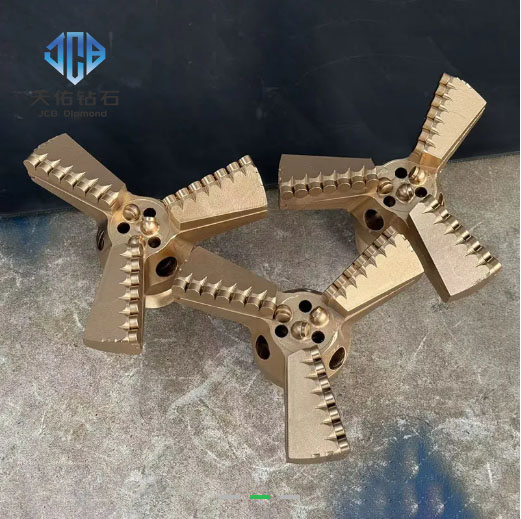
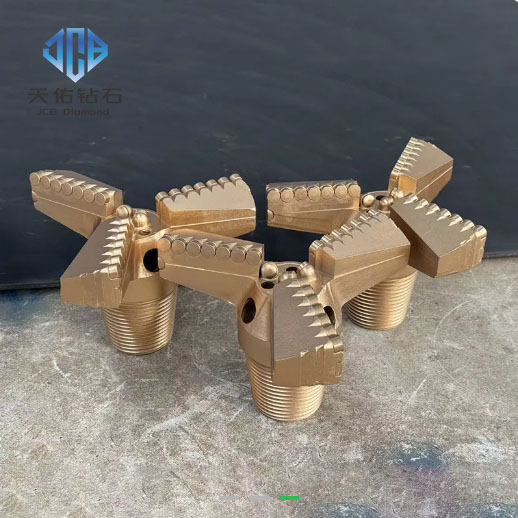
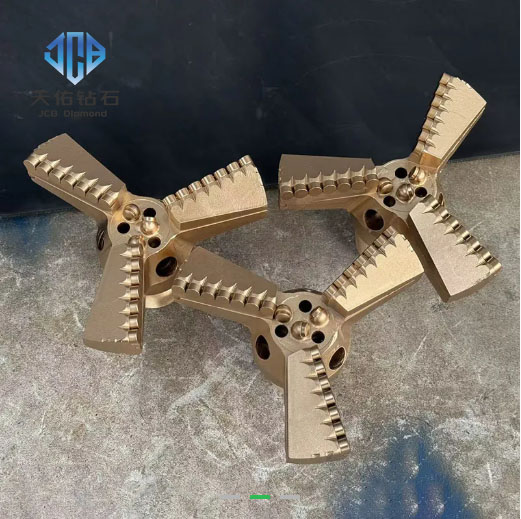
9 7/8″ 3‑Blade PDC Diamond Bit for Well Drilling
Using a tractor‑driven drilling rig as an example, the following main assemblies can be distinguished:
Power supply and transmission system: The tractor's output shaft, via a universal joint, drives a reduction gearbox, adjusting the speed to the required value for the hydraulic pump.
Hydraulic system: Includes a hydraulic oil pump, motor, directional valve, speed control valve, etc., which ensures independent and stable control of bit rotation and feed rate, and also has an overload protection function.
Drilling device: Consists of the drill bit, pulley, and guide. The drill bit is generally composed of a bit head, blades, spiral flights, and a spindle. It is rotated by a hydraulic motor, while another motor controls its lifting and feeding via a chain drive.
Working process includes two parts: soil cutting and lifting. When the drill bit rotates and feeds downward, the spiral flights transport the soil upward along a specific trajectory. To ensure continuity of operation, the rotational speed of the drill bit must be above a critical value determined theoretically. The movement of soil on the drill bit surface can be divided into three zones to ensure effective soil lifting.
| Size | Thread Type (Pin) | Weight (lbs) |
|---|
| 3 7/8" – 4 3/4" | 2 3/8" REG Pin | 6 |
| 4 7/8" – 5 1/8" | 2 3/8" REG Pin | 7 |
| 5 1/4" – 5 1/2" | 2 3/8" REG Pin | 8 |
| 4 5/8" – 5" | 2 7/8" REG Pin | 10 |
| 5 1/8" – 5 1/2" | 2 7/8" REG Pin | 11 |
| 5 5/8" – 6 1/4" | 3 1/2" REG Pin | 18 |
| 6 1/2" – 6 3/4" | 3 1/2" REG Pin | 19 |
| 7" – 7 1/2" | 3 1/2" REG Pin | 21 |
| 7 5/8" – 8" – 12 1/4" | 3 1/2" REG Pin / 4 1/2" / 6 5/8" | 23 |
Three‑blade step drag bits are manufactured as a one‑piece alloy steel construction with tungsten carbide cutting tips and gauge‑protecting side surfaces for extended service life. They have 3 blades and 3 wash ports. Compared to 4‑blade designs, 3‑blade step drag bits generally drill faster and more aggressively, but have a shorter service life and are less durable. 3‑blade step drag bits generate greater cutting force than chevron‑type bits. When using step drag bits, the rotary table speed should be maintained between 60 and 80 rpm with a light weight‑on‑bit (WOB).
Three‑blade step drag bits are a cost‑effective drilling tool for soft geological formations at shallow depths; they are primarily intended for soft to medium‑hard formations such as clay, loam, silt, and most soft to medium‑hard soils with a certain moisture content, etc. Furthermore, step drag bits are recommended for drilling in mining, geological exploration, environmental applications, water well construction, geothermal systems, and similar projects.
3‑Wing Step Drag Bits
| Diameter | Thread |
|---|
| From 2 to 17½ inches (50.8 – 444.5 mm) | Optional (as required) |
Note: The diameters and threads listed above are standard sizes; other sizes are available upon request.
Thread sizes available:
2 3/8″ REG, 2 7/8″ REG, 3 1/2″ REG, 4 1/2″ REG, 6 5/8″ REG, 2″ API IF, 2 3/8″ IF, 2 7/8″ IF, A Rod, N Rod, AW, BW, NW, AWJ, BWJ, NWJ.